For anyone planning to study abroad, seeking medical treatment overseas, or simply booking a long-awaited international vacation, the Union Budget 2026 has brought some of the most taxpayer-friendly news in years. Effective from April 1, 2026, the rules governing Tax Collected at Source (TCS) under the Liberalised Remittance Scheme (LRS) have been significantly rationalized.
The primary goal of these changes is to solve the “liquidity crunch” caused by the high TCS rates introduced in previous years. While TCS is technically a refundable advance tax, having 20% of your travel budget or 5% of your tuition fees blocked for months until you file your tax return was a major financial hurdle.
Key Highlights of the New Rule (FY 2026-27)
1. Major Relief for Students and Patients
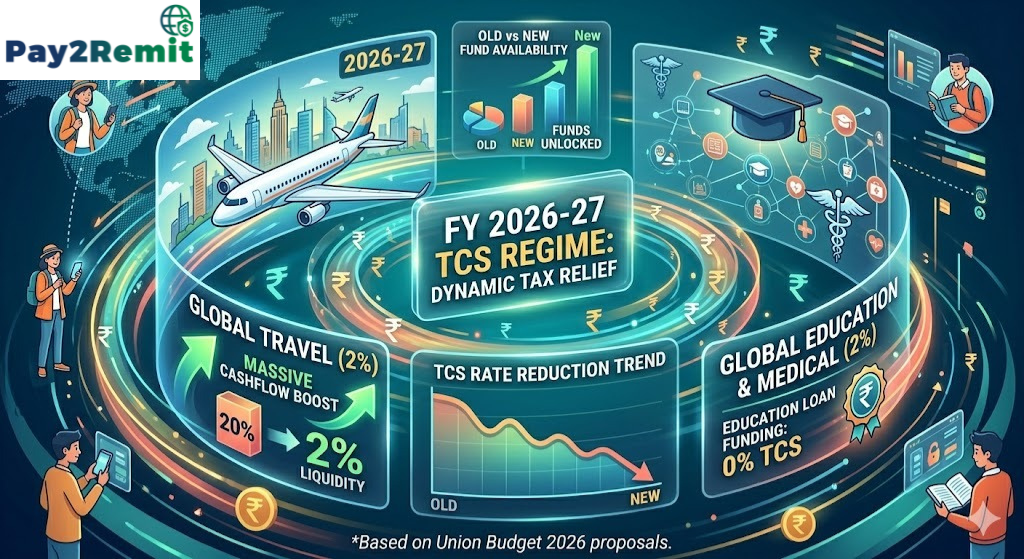
Previously, self-funded education and medical treatments attracted a 5% TCS once you crossed the ₹10 lakh threshold. For FY 2026-27, this has been slashed to 2%. This 60% reduction in the tax rate ensures that families don’t have to over-budget for upfront tax payments while managing essential expenses.
2. The End of the “20% Shock” on Travel
Perhaps the biggest win is for the travel industry. Under the old rules, overseas tour packages were subject to a tiered system: 5% up to ₹10 lakh and a staggering 20% thereafter. Starting April 2026, this tiered system is gone. It is replaced by a flat 2% TCS from the very first rupee, with no upper threshold for the lower rate.
3. Threshold Limits Maintained
The exemption threshold for general remittances (like gifts, investments, or maintenance of relatives) remains at ₹10 lakh. This means you can remit up to this amount in a financial year without any TCS being triggered, provided the purpose isn’t an overseas tour package.
TCS Rate Comparison: Old vs. New
To understand how much you’ll save in “blocked capital,” here is a side-by-side comparison of the rates applicable in the previous fiscal year versus the new rates for FY 2026-27.
| Nature of Remittance | Previous Rates (FY 2025-26) | New Rates (FY 2026-27) |
|---|---|---|
| Education (via Bank Loan) | 0.5% (above ₹10 Lakh) | 0% (Complete Exemption) |
| Education (Self-funded) | 5% (above ₹10 Lakh) | 2% (above ₹10 Lakh) |
| Medical Treatment | 5% (above ₹10 Lakh) | 2% (above ₹10 Lakh) |
| Overseas Tour Packages | 5% up to ₹10L; 20% above ₹10L | Flat 2% (No Limit) |
| Investments/Gifts/Other | 20% (above ₹10 Lakh) | 20% (above ₹10 Lakh) |
Why This Matters for Your Wallet
Let’s look at a quick example. If you were planning an international luxury tour costing ₹15 lakh:
- Under Old Rules: You would pay 5% on the first ₹10 lakh (₹50,000) and 20% on the remaining ₹5 lakh (₹1,00,000), totaling ₹1,50,000 in TCS.
- Under New Rules: You pay a flat 2% on ₹15 lakh, which is only ₹30,000.
That is an immediate cash-flow saving of ₹1,20,000!
Pro-Tips for Remitters
- Track Your Limits: Even with lower rates, remember that the ₹10 lakh threshold is an aggregate across all banks.
- Claim Your Refund: TCS is not a “cost”—it’s a tax credit. Ensure you collect your TCS Certificate (Form 27D) from your bank to adjust this amount against your final income tax liability or claim it as a refund during ITR filing.
- Education Loans: If you are financing studies through a loan from a recognized financial institution, the TCS is now entirely waived, making it the most tax-efficient way to fund foreign degrees.
The FY 2026-27 rules represent a shift toward a more “open economy” mindset, prioritizing ease of doing business and personal financial freedom. Happy traveling and happy learning! ✈️📚