
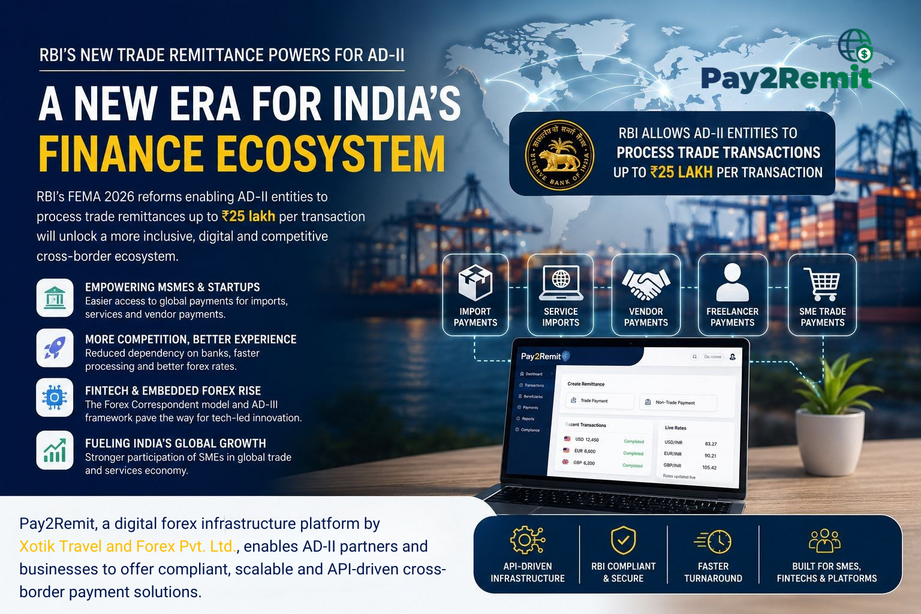
The Reserve Bank of India’s latest FEMA 2026 reforms may quietly become one of the biggest shifts in India’s cross-border financial ecosystem over the next few years. By allowing AD Category-II entities to process foreign trade transactions up to ₹25 lakh per transaction, along with broader non-trade outward remittances, RBI has effectively expanded the forex ecosystem beyond traditional banking institutions.
Until now, most outward trade remittances were heavily dependent on large banks. This created multiple challenges for Indian SMEs, startups, students, travel operators, freelancers, and digital businesses, including:
- Slower processing
- Complex documentation
- Poor customer experience
- Limited technology integration
- High transaction costs
India’s economy is rapidly becoming digital-first, but cross-border forex infrastructure remained largely bank-centric and operationally outdated. RBI’s new framework appears to recognize this gap.
A Major Opportunity for MSMEs and Startups
The biggest impact of these reforms will likely be seen in the MSME and startup ecosystem.
Thousands of Indian businesses today import services, software, digital products, marketing solutions, and small commercial consignments from overseas vendors. However, many of these transactions fall below large corporate banking thresholds and therefore never receive efficient servicing.
By empowering AD-II entities to process trade remittances up to ₹25 lakh, RBI is decentralizing access to international payments. This move is expected to:
- Increase competition in the forex ecosystem
- Improve customer experience
- Reduce dependency on traditional banking channels
- Enable faster routine outward remittances
- Encourage innovation in cross-border financial services
The Rise of Fintech-Led Forex Infrastructure
Another major shift is the increasing role of fintech infrastructure in regulated forex transactions.
RBI’s introduction of the Forex Correspondent model and the new AD Category-III framework signals a future where technology companies can participate in forex ecosystems under regulated partnerships.
This could lead to the rise of embedded forex solutions where:
- Travel companies offer instant forex services
- Education platforms integrate tuition remittances
- SME software platforms provide vendor payment solutions
- Digital marketplaces enable global payouts directly through APIs
India’s outward remittance ecosystem may soon resemble the transformation already seen in UPI and digital payments.
The Role of Pay2Remit in This New Ecosystem
This is where Pay2Remit becomes highly relevant.
Developed under the vision of Xotik Travel & Forex Pvt. Ltd., Pay2Remit was designed as a digital forex infrastructure platform capable of enabling white-label and API-driven cross-border remittance solutions.
In a regulatory environment where AD-II entities can now facilitate broader outward remittances, platforms like Pay2Remit can act as the technology bridge between regulated forex institutions and digital businesses.
Instead of every fintech or platform seeking its own forex authorization, regulated AD-II players can now collaborate with technology providers to create compliant, scalable, and user-friendly remittance ecosystems.
The Long-Term Impact on India’s Financial Ecosystem
The long-term impact of these reforms could be transformational for India’s financial infrastructure.
Potential outcomes include:
- Faster outward remittances
- Improved forex accessibility
- Digital compliance automation
- Better SME participation in global trade
- Deeper fintech innovation in India’s regulated forex sector
RBI’s message is becoming increasingly clear: the future of India’s forex ecosystem will not be driven only by banks, but by regulated, technology-led financial infrastructure.
AD-II institutions equipped with strong digital capabilities may emerge as the backbone of the next phase of India’s global financial connectivity.