RBI Introduces a New Era for Forex and Cross-Border Transactions
India’s cross-border payments ecosystem is entering a major transformation phase.
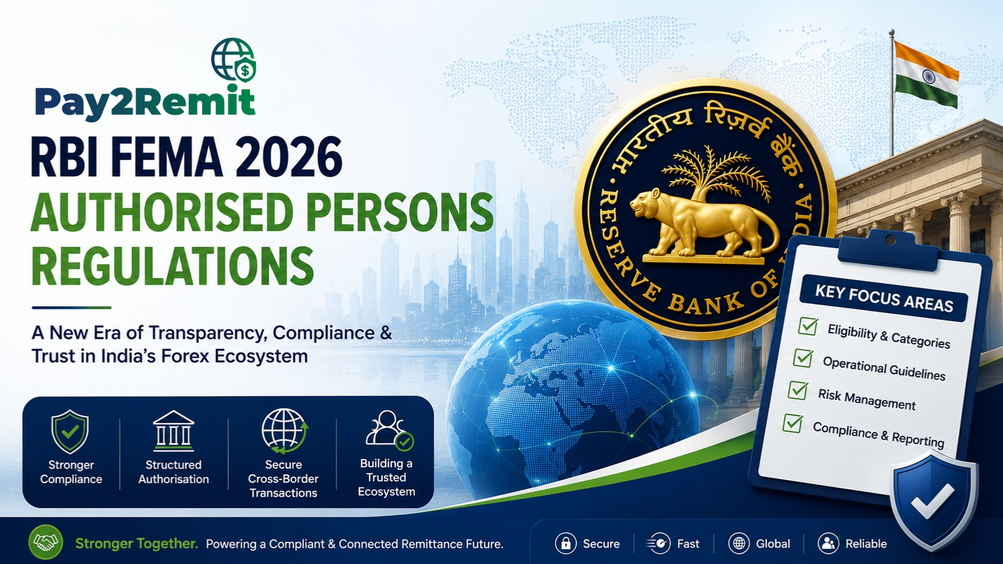
With the introduction of the Foreign Exchange Management (Authorised Persons) Regulations, 2026, the Reserve Bank of India (RBI) has reshaped the regulatory architecture governing authorised dealers, forex entities, money changers, and foreign exchange intermediaries.
The notification introduces a more structured, compliance-driven, technology-oriented, and scalable framework for foreign exchange operations in India.
For fintech companies, remittance platforms, NBFCs, forex businesses, educational payment facilitators, travel payment providers, and cross-border infrastructure companies like Pay2Remit, these regulations represent:
- A compliance milestone
- A strategic growth opportunity
- A shift toward a more digitally governed forex ecosystem
This regulatory evolution also signals RBI’s broader intent to modernize India’s foreign exchange infrastructure while improving:
- Transparency
- Governance standards
- Operational accountability
- Customer protection
- Institutional quality
Understanding the FEMA 2026 Authorised Persons Regulations
The RBI notification titled:
Foreign Exchange Management (Authorised Persons) Regulations, 2026
has been issued under the powers granted by:
- Foreign Exchange Management Act (FEMA), 1999
- Section 10 and Section 47 of FEMA
The regulations officially came into force on:
30 April 2026
The new framework replaces and modernizes several legacy operational structures surrounding:
- Authorised Dealers (ADs)
- Full Fledged Money Changers (FFMCs)
- Forex intermediaries
- Franchisee models
- Forex correspondents
- Foreign exchange compliance structures
The regulations also redefine how forex-related businesses can operate, expand, scale, and maintain compliance in India.
Why These Regulations Matter for India’s Cross-Border Economy
India is one of the world’s largest remittance and outward payment economies.
The country processes:
- International education payments
- Medical remittances
- Import/export settlements
- Freelance and creator economy payouts
- Travel-related forex transactions
- Overseas investments
- Family remittances
- SaaS and service exports
As transaction volumes rise, RBI is clearly moving toward:
- Better supervision
- Stronger governance
- Digitized oversight
- Improved customer safeguards
- Reduced regulatory arbitrage
- Better operational accountability
The FEMA 2026 framework reflects RBI’s intent to align India’s forex ecosystem with the realities of modern fintech infrastructure.
Key Highlights of RBI FEMA 2026 Regulations
1. Introduction of Three Structured Authorised Dealer Categories
RBI now formally recognizes three major categories of Authorised Dealers.
AD Category-I
Typically banks licensed by RBI.
Permitted activities include:
- Current account transactions
- Capital account transactions
- Broad FEMA-authorised forex operations
AD Category-II
This category now includes:
- RBI-licensed banks
- RBI-registered NBFCs
- Eligible FFMCs
- Eligible Forex Correspondents
Important conditions include:
- Minimum net worth requirement: ₹10 crore
- Minimum annual forex turnover: ₹50 crore
- Prior operational history requirements for FFMC/FxC entities
AD Category-II entities can facilitate:
- Non-trade current account transactions
- Foreign trade transactions up to ₹25 lakh per transaction
AD Category-III
This is one of the most interesting additions in the framework.
It opens the door for:
- Innovative forex-linked business models
- Specialized entities
- Emerging fintech infrastructure companies
- Technology-driven payment ecosystems
Minimum net worth requirement:
- ₹2 crore
This category could significantly accelerate innovation in India’s regulated cross-border payment ecosystem.
RBI Is Moving Away From Traditional Franchisee Models
One of the biggest structural changes in the notification is RBI’s gradual discontinuation of the old franchisee model.
Under the new regulations:
- Fresh franchisee arrangements are no longer permitted
- Existing franchisee arrangements must be discontinued within two years
- Franchisees may instead transition into Forex Correspondents (FxC)
This is a major policy signal.
RBI is clearly encouraging:
- Better accountability structures
- Stronger principal-agent governance
- Improved operational supervision
- More transparent transaction reporting
This shift also reduces compliance fragmentation in the ecosystem.
Introduction of the Forex Correspondent (FxC) Framework
The newly formalized Forex Correspondent Scheme (FCS) is one of the most transformative aspects of the regulations.
Under this structure:
- AD Category-I and AD Category-II entities can appoint Forex Correspondents
- Operations will function under a principal-agent model
- FxCs can conduct approved forex activities
- Transactions remain under the principal’s oversight
Permitted activities include:
- Purchase of foreign currency
- Sale of forex for travel purposes
- MTSS-related services
This model creates a scalable infrastructure layer for expanding forex access across India.
It also supports:
- Wider geographic penetration
- Better service accessibility
- Digitized forex distribution networks
- Faster customer servicing
- Controlled compliance supervision
Stronger “Fit and Proper” Governance Requirements
RBI has significantly strengthened governance standards.
Applicants, promoters, directors, and Key Managerial Personnel (KMPs) must satisfy strict “fit and proper” criteria.
The evaluation includes:
- Financial services experience
- Integrity and reputation
- Regulatory track record
- Absence of criminal proceedings
- Absence of regulatory sanctions
- Corporate governance standards
Additionally:
- At least 50% of directors and KMPs must possess financial services experience
- Enhanced due diligence expectations now apply
- RBI may reject applications not considered in public interest
This clearly reflects RBI’s intent to elevate institutional quality across the forex sector.
Continuous Compliance Becomes Mandatory
The regulations introduce continuous compliance obligations rather than one-time approval-based oversight.
Entities must continuously maintain:
- Net worth thresholds
- Forex turnover requirements
- Fit-and-proper status
- Reporting obligations
- Governance standards
Important reporting obligations include:
- Reporting management changes
- Reporting KMP changes
- Reporting investigations
- Reporting ownership/control changes
- Reporting business location changes through APConnect
This moves India’s forex ecosystem toward a more dynamic supervisory model.
PRAVAAH and APConnect Signal RBI’s Digital Compliance Push
The framework integrates RBI’s digital infrastructure platforms.
PRAVAAH Portal
Used for:
- Authorisation applications
- Regulatory submissions
- Approval workflows
APConnect
Used for:
- Reporting operational changes
- Location updates
- Forex correspondent disclosures
- Regulatory communication
This is a strong indicator that RBI is building a digitally supervised forex ecosystem with:
- Better traceability
- Faster oversight
- Improved compliance monitoring
- Reduced manual inefficiencies
What These Regulations Mean for Fintech and Cross-Border Payment Companies
The FEMA 2026 framework is especially significant for fintech and cross-border infrastructure companies.
The regulations effectively acknowledge that modern forex ecosystems are no longer limited to traditional banking institutions.
Instead, RBI is recognizing:
- Technology-led payment systems
- Embedded finance models
- API-driven forex infrastructure
- Regulated fintech partnerships
- Digital-first forex distribution
- Cross-border payment orchestration platforms
This creates new possibilities for compliant innovation.
Implications for Students, Freelancers, Businesses, and Global Indians
For International Students
The regulations strengthen the ecosystem supporting:
- Tuition fee payments
- University remittances
- Living expense transfers
- Education-focused forex servicing
Students and parents increasingly expect:
- Faster payments
- Transparent forex rates
- Simplified documentation
- Reliable payment tracking
- Compliance-safe transactions
The regulatory modernization supports all these expectations.
For Importers and Exporters
Businesses dealing with overseas suppliers require:
- Faster settlement cycles
- Better forex transparency
- Reduced operational friction
- Regulatory clarity
The structured AD framework and digitally governed reporting environment may improve operational efficiency across the trade ecosystem.
For Freelancers and Digital Professionals
India’s creator economy and freelance economy are increasingly global.
Professionals now regularly receive:
- International client payments
- Platform payouts
- Service export revenue
- Consulting fees
- SaaS income
A modernized forex ecosystem supports:
- Better transaction infrastructure
- Improved compliance pathways
- Stronger operational legitimacy
For Travel and Forex Customers
The FxC model may significantly improve:
- Accessibility to forex services
- Regional forex availability
- Travel currency servicing
- Operational convenience
This could help expand forex accessibility beyond major metro markets.
What This Means for Pay2Remit
At Pay2Remit, regulatory alignment is not viewed merely as a compliance requirement.
It is viewed as foundational infrastructure.
The FEMA 2026 regulations reinforce the importance of:
- Transparent cross-border payment systems
- Scalable compliance architecture
- Technology-led operational workflows
- Secure forex servicing
- Digitized onboarding and reporting
- Institutional-grade governance
As the global payments ecosystem becomes increasingly interconnected, businesses and individuals need payment partners that understand both:
- Regulatory expectations
- Modern customer experience standards
Pay2Remit continues to focus on enabling:
- Secure cross-border remittances
- International education payments
- Business payment facilitation
- Forex-enabled financial workflows
- Technology-first payment experiences
while remaining aligned with India’s evolving regulatory ecosystem.
Strategic Industry Shift: RBI Is Building a More Structured Forex Ecosystem
The broader signal from FEMA 2026 is extremely important.
RBI is moving India toward a forex ecosystem that is:
- More accountable
- More technology-driven
- More compliance-centric
- More scalable
- More institutionally governed
- Better suited for fintech integration
This is not merely a regulatory update.
It is a structural modernization initiative.
The introduction of:
- FxC frameworks
- Digital reporting systems
- Continuous compliance obligations
- Enhanced governance standards
- Structured authorisation categories
collectively indicates RBI’s long-term vision for India’s foreign exchange ecosystem.
Challenges Businesses Must Prepare For
While the framework creates growth opportunities, it also raises the compliance bar significantly.
Businesses operating in forex or cross-border payments must now prepare for:
Higher Governance Expectations
Boards, promoters, and KMPs face stricter scrutiny.
Stronger Documentation Standards
Regulatory submissions and operational disclosures must be more robust.
Continuous Reporting Requirements
Compliance becomes ongoing rather than periodic.
Technology Infrastructure Readiness
Digital reporting systems require operational maturity.
Risk Management Requirements
Especially for outsourced and partner-driven models.
Entities that fail to adapt may face:
- Authorisation rejection
- Operational restrictions
- Increased supervisory attention
- Potential revocation risks
The Future of Cross-Border Payments in India
India is rapidly emerging as one of the world’s most important digital financial ecosystems.
The future of cross-border payments will likely be shaped by:
- Embedded finance
- API-first infrastructure
- AI-driven compliance systems
- Automated KYC workflows
- Real-time payment intelligence
- Integrated forex ecosystems
- Digital remittance infrastructure
The FEMA 2026 regulations provide a stronger regulatory foundation for this future.
Final Thoughts
The RBI’s Foreign Exchange Management (Authorised Persons) Regulations, 2026 represent a significant milestone in the evolution of India’s forex and cross-border payments ecosystem.
The framework strengthens:
- Governance
- Transparency
- Digital supervision
- Operational accountability
- Institutional quality
- Compliance integrity
At the same time, it opens new possibilities for fintech-led innovation and scalable forex infrastructure.
For businesses, payment providers, NBFCs, forex operators, students, travelers, freelancers, and global Indian consumers, these regulations signal the beginning of a more structured and technologically mature cross-border ecosystem.
As India continues to expand its global economic footprint, regulatory modernization will play a critical role in enabling trusted, scalable, and future-ready international payment infrastructure.
Frequently Asked Questions (FAQs)
What are the FEMA 2026 Authorised Persons Regulations?
The FEMA 2026 regulations are RBI-issued rules governing authorised dealers, forex intermediaries, money changers, and foreign exchange-related entities operating under FEMA.
What is a Forex Correspondent (FxC)?
A Forex Correspondent is an agent appointed by an AD Category-I or AD Category-II entity under the Forex Correspondent Scheme for conducting approved forex activities.
Has RBI discontinued forex franchisee arrangements?
RBI has prohibited fresh franchisee arrangements and directed existing arrangements to transition within two years.
What is the minimum net worth required for AD Category-II?
The regulations specify a minimum net worth requirement of ₹10 crore for AD Category-II entities.
What is the significance of AD Category-III?
AD Category-III may support innovative forex-linked and fintech-driven business models requiring foreign exchange functionality.
How do these regulations impact fintech companies?
The framework creates a more structured environment for compliant fintech innovation in cross-border payments and forex infrastructure.